
Your aviation career rests on a single sheet of paper renewed every six to twelve months. That Class 1 medical certificate represents more than regulatory compliance—it’s the on/off switch controlling access to an income stream potentially worth over £1 million across a flying career. The uncomfortable mathematics are straightforward: higher pilot salaries don’t just mean better living standards, they create larger absolute financial exposure the moment medical certification fails. A captain earning £110,000 annually faces fundamentally different vulnerability than a newly qualified first officer on £48,000, yet both share identical binary risk—you’re either medically fit to fly commercially, or you’re not.
The financial exposure equation in four critical points:
- Pilot income creates mathematical vulnerability—earning £100,000 annually means £2 million absolute career exposure over 20 remaining years, far exceeding emergency fund capacity
- Training debt of £80,000-£120,000 (typical UK ATPL investment) compounds early-career financial fragility when medical restrictions emerge
- Industry data suggests 8-12% of professional pilots encounter medical restrictions during their career, with cardiovascular conditions representing the most frequent trigger
- Loss of licence insurance fundamentally alters the equation—50-75% income replacement versus total financial collapse if certification fails
Why your pilot salary creates a mathematical vulnerability
The aviation profession contains a financial paradox rarely discussed during flight training: your increasing income simultaneously elevates your absolute risk exposure. A first officer progressing from £52,000 to £68,000 isn’t just improving their standard of living—they’re expanding the mathematical gap between what emergency savings can realistically cover and what medical disqualification would actually cost. As highlighted by the testimony published by BALPA, every pilot’s financial situation after medical certificate loss proves unique, with even structured income transition schemes frequently falling short of requirements.
Consider the arithmetic from a purely exposure perspective. A captain with 18 years remaining until mandatory retirement at age 65, currently earning £105,000 annually, carries £1.89 million in absolute career earnings at stake. Even maintaining an exemplary emergency fund of 12 months’ expenses (perhaps £45,000 in accessible savings) creates a protection ratio of barely 2.4% against total exposure. The comfortable salary that funds mortgage payments, family education costs, and retirement contributions becomes a liability the instant Class 1 medical certification status changes from valid to suspended.
£1.89million
Absolute career earnings exposure for a captain earning £105,000 with 18 years to retirement—a sum no emergency fund can realistically replace
This vulnerability intensifies rather than diminishes as careers progress. While senior captains typically maintain stronger financial buffers and lower debt-to-income ratios than newly qualified officers, they face higher absolute loss amounts. The first officer with £58,000 annual income and £72,000 training debt occupies a precarious position—but loses “only” £1.45 million over a 25-year horizon. The senior captain loses £1.89 million over fewer years at higher annual rates. Both scenarios represent career-ending financial shocks, yet the protection conversation often focuses exclusively on early-career vulnerability whilst ignoring the peak-earnings exposure pattern.
The income equation across pilot career stages
Financial exposure shifts dramatically across aviation career progression, but not in the linear pattern most pilots anticipate. The relationship between earnings, debt obligations, savings capacity, and remaining career duration creates distinct risk profiles at each stage—profiles that determine both the urgency and structure of income protection requirements. Industry analysis from specialized aviation insurers, handling 250+ claims annually across 10,000+ professional and trainee pilots worldwide, reveals these patterns consistently across all career stages.
The newly qualified first officer represents maximum financial fragility despite lower absolute income. Typical UK ATPL training investment ranges from £80000 to £120,000, creating debt obligations that often exceed annual starting salary (£42,000-£50,000 at regional carriers). This debt-to-income ratio—sometimes exceeding 2:1—means medical disqualification triggers dual crisis: income cessation and debt default risk simultaneously. Emergency fund capacity remains minimal during this phase. Industry observations suggest 1-3 months of expenses represents typical savings for pilots within their first three years post-qualification. When monthly debt servicing already consumes £800-£1,200 of take-home pay, building meaningful financial buffers becomes structurally difficult. A medical suspension lasting beyond a brief sick pay period (often 4-8 weeks full pay depending on airline) immediately creates existential cash flow crisis.

The established first officer profile—typically 5-12 years post-qualification, earning £55,000-£70,000—shows improving financial metrics but persistent exposure. Training debt has reduced to £20,000-£50,000 remaining, and emergency funds have expanded to 3-6 months of expenses. However, this career stage frequently coincides with major financial commitments: mortgage deposits, family formation, education costs for children. These new obligations often consume the income growth that might otherwise have built protection. The first officer earning £64,000 with a £285,000 mortgage, partner on maternity leave, and £28,000 training debt remaining appears financially stable—until medical certification fails. Fixed costs (mortgage, childcare, debt servicing) typically represent 65-75% of net household income during this phase, leaving minimal flexibility to absorb income loss. Seeking guidance on managing competing financial priorities while maintaining protection? Understanding your financial balance without guilt becomes essential when evaluating insurance costs against immediate budget constraints.
Senior captain positions (£120,000-£150,000 annually) represent career pinnacle and maximum absolute financial exposure simultaneously. Training debt has been eliminated, emergency funds often exceed 12 months of expenses, and pension contributions have accumulated meaningful value. Yet the captain with 10 remaining years to retirement earning £138,000 faces £1.38 million absolute career exposure—a figure that dwarfs even substantial savings. This cohort also confronts increasing medical examination frequency. The Civil Aviation Authority’s certification framework reduces medical validity from 12 months to 6 months for pilots over 60, effectively doubling the annual opportunities for conditions to be detected or emerge. Age-correlated health risks (cardiovascular changes, metabolic conditions, cumulative lifestyle factors) intersect with shortened certification cycles precisely when absolute earnings exposure remains highest.
The table below compares financial exposure across four distinct pilot career stages, examining six critical variables simultaneously: income level, remaining training debt, typical emergency fund capacity, years to retirement, and total absolute career earnings at stake. The ‘Absolute Career Exposure’ column represents simple multiplication of annual income by remaining years—a stark visualization of how much future earning potential depends on continued medical certification. Locate your current career stage to identify your specific vulnerability profile.
Data comparative compiled and updated January 2026.
| Career Stage | Typical Annual Income | Training Debt Remaining | Emergency Fund (Months) | Years to Retirement | Absolute Career Exposure |
|---|---|---|---|---|---|
| Newly Qualified FO | £42,000-£50,000 | £60,000-£100,000 | 1-3 months | 35-40 years | £1,470,000-£2,000,000 |
| Established FO | £55,000-£70,000 | £20,000-£50,000 | 3-6 months | 25-30 years | £1,375,000-£2,100,000 |
| Newly Promoted Captain | £85,000-£110,000 | £0-£15,000 | 6-12 months | 15-20 years | £1,275,000-£2,200,000 |
| Senior Captain | £120,000-£150,000 | £0 | 12+ months | 8-12 years | £960,000-£1,800,000 |
What actually triggers Class 1 medical failures
Medical disqualification remains abstract until examining the specific conditions that actually terminate flying careers. Claims data and aeromedical examiner observations reveal patterns far removed from catastrophic health events—the majority of Class 1 failures stem from detectable, manageable conditions that nonetheless breach regulatory thresholds for commercial flight safety.
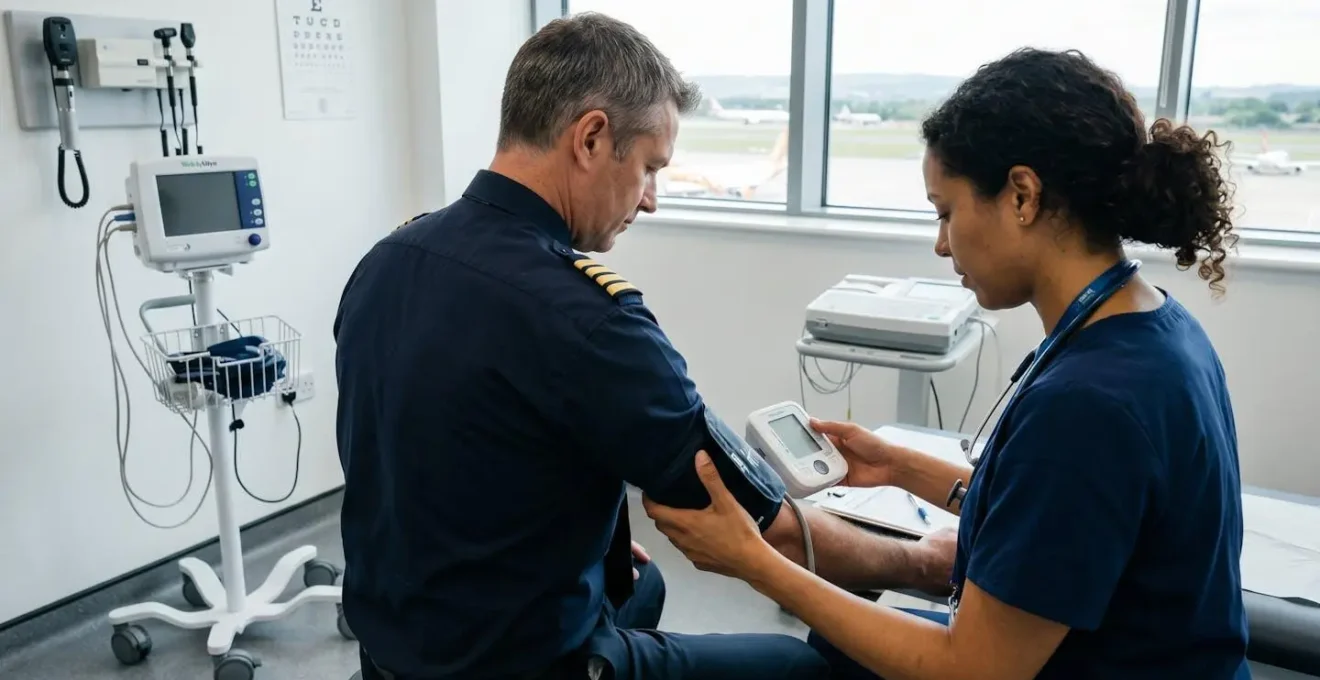
Cardiovascular conditions dominate the medical failure landscape. Hypertension exceeding CAA thresholds (typically systolic >160 mmHg or diastolic >95 mmHg sustained), cardiac arrhythmias detected during ECG examination, and coronary artery disease indicators trigger immediate certification concerns. The regulatory framework outlined by the European Union Aviation Safety Agency in their official FAQs maintains zero tolerance for conditions presenting in-flight incapacitation risk, regardless of symptom severity in daily life. A pilot managing mild hypertension with lifestyle modifications may feel perfectly healthy yet fail to meet the binary pass/fail standard required for Class 1 renewal.
The conditions ending commercial flying careers most frequently:
Aviation medical examiners consistently identify several primary disqualification categories:
- Cardiovascular issues (hypertension, arrhythmia, coronary disease evidence)
- Mental health conditions (anxiety disorders, depression detected during psychological screening)
- Type 2 diabetes requiring insulin management
- Certain cancer diagnoses even after successful treatment
- Neurological conditions affecting cognitive function
- Vision deterioration beyond correctable thresholds
The concerning pattern: a substantial proportion of these conditions emerge during routine examinations in pilots who considered themselves medically fit, with no advance warning symptoms.
Mental health assessment has evolved from peripheral concern to central certification component. Depression, anxiety disorders, and stress-related conditions now represent significant disqualification factors, with screening protocols intensifying following industry-wide recognition of psychological health impact on flight safety. The challenge: mental health conditions often develop gradually, remain undiagnosed until formal assessment, and carry substantial stigma that may delay voluntary disclosure.
Metabolic conditions create another major failure pathway. Type 2 diabetes requiring insulin therapy triggers automatic Class 1 suspension under current CAA standards, though some cases may qualify for restricted certification after extensive evaluation. The progression from pre-diabetic status to insulin dependence can occur within months, transforming a manageable health condition into career-ending medical disqualification.
What makes these patterns particularly relevant to the financial exposure equation: onset unpredictability. Unlike gradual vision deterioration that provides years of warning, cardiovascular events or mental health crises can emerge between medical examinations with minimal advance indication. Industry analysis suggests approximately 8-12% of professional pilots will encounter some form of medical restriction during their career—a probability far exceeding most pilots’ subjective risk assessment.
How protection insurance recalibrates the equation
Loss of licence insurance fundamentally alters the financial mathematics by converting catastrophic absolute loss into manageable proportional coverage. Rather than facing £1.5 million career earnings elimination, the insured pilot receives structured income replacement—typically 50-75% of pre-disability salary—continuing until retirement age or policy term expiration. This transformation doesn’t eliminate medical risk, but it does eliminate the financial collapse that medical disqualification would otherwise trigger.
The protection mechanism operates through own-occupation definition—the critical policy component for specialised professionals. Pilot SAAM‘s pilot insurance coverage, developed specifically for Class 1 certificate holders through their partnership with Swiss Life, pays benefits when medical certification prevents commercial flying duties specifically, regardless of ability to work in other capacities. This contrasts sharply with generic income protection policies using “any occupation” definitions, where insurers could deny claims if the pilot remains capable of ground-based employment. For aviation professionals with highly specialised skills and limited career transferability, own-occupation wording represents the difference between genuine protection and illusory coverage.

Premium structures reflect individual risk profiles: age, medical history, aircraft type, flight hours, and income level all influence cost. A 32-year-old first officer earning £58,000 might expect annual premiums around £1,800-£2,400 for comprehensive coverage, whilst a 48-year-old captain on £115,000 could face £4,500-£6,500 annually. The cost-benefit analysis requires comparing these premiums against absolute exposure and existing financial buffers. For the newly qualified pilot with £85,000 training debt and minimal savings, even £2,200 annual premium represents essential financial architecture despite tight cash flow. For the senior captain with £180,000 in accessible assets, the calculation becomes whether £5,800 annual cost represents efficient risk transfer compared to self-insurance capacity.
Benefit period selection proves equally critical. Coverage extending to retirement age (typically 65 for commercial pilots) provides complete career protection but commands higher premiums than fixed terms (10, 15, or 20 years). A 35-year-old pilot with 30 remaining career years faces dramatically different protection needs than a 55-year-old with 10 years to mandatory retirement. Matching benefit period to actual career timeline prevents both over-insurance (paying for unnecessary coverage years) and under-insurance (benefits expiring whilst significant career earnings remain at stake).
- If you carry high training debt (>£50,000 remaining) OR qualified less than 5 years:
Question: Do you support dependents or maintain significant fixed commitments (mortgage, family obligations)?
- Yes – dependents or mortgage present: PRIORITY URGENT. Your financial vulnerability reaches critical levels—the combination of substantial debt, limited career buffer, and dependent responsibilities creates extreme exposure. Research loss of licence insurance immediately, even if premium costs require budget restructuring. Medical disqualification would trigger simultaneous income loss and potential debt default whilst family obligations continue.
- No – single with minimal fixed costs: PRIORITY HIGH. Focus on building a 6-month emergency fund as immediate step, then implement loss of licence coverage within 12 months maximum. Your debt burden alone creates serious vulnerability, though absence of dependents provides marginally more flexibility for phased protection approach.
- If you maintain moderate debt (£15,000-£50,000) OR 5-15 years post-qualification:
Question: What is your emergency fund status currently?
- Less than 3 months expenses saved: PRIORITY MEDIUM-HIGH. Build emergency fund to 3 months simultaneously with researching insurance options. Target loss of licence coverage implementation within 6 months. You possess some financial maturity but remain vulnerable—parallel approach balances immediate liquidity requirements with long-term career protection.
- 6+ months expenses saved: PRIORITY MEDIUM. Your buffer provides breathing room for short-term disruption but cannot replace £1+ million career earnings exposure. Evaluate loss of licence insurance within 12 months as income increases and financial situation stabilises further.
- If you carry low/no debt (<£15,000) AND established career (15+ years qualified):
Question: How many years remain to retirement and what is current income level?
- 10+ years to retirement, income exceeding £90,000: PRIORITY MEDIUM. High absolute exposure (£900,000+) persists despite financial maturity. Evaluate whether annual premium (likely £4,000-£7,000) represents superior risk transfer compared to self-insuring remaining career earnings. The absolute amount at stake may justify insurance as efficient protection even with strong financial position.
- Less than 10 years to retirement OR passive income sources established: PRIORITY LOW-MEDIUM. Assess complete financial picture including pension value, investment assets, partner income sources. Insurance may prove unnecessary if net worth can sustain lifestyle without pilot income, but calculate actual gap between accessible assets and remaining career earnings before deciding.
Making informed protection decisions extends beyond insurance evaluation alone—it requires developing comprehensive financial analysis skills across all major commitments and opportunities. The decision framework above addresses immediate insurance priority, but your broader financial architecture must also account for pension adequacy, mortgage protection strategies, dependent education funding, and career transition contingency planning. As income levels increase throughout your aviation career, regular reassessment ensures coverage amounts remain proportional to actual exposure rather than fossilized at initial policy inception levels. Tax-efficient structuring of protection premiums, coordination with employer-provided benefits, and integration with partnership or trust arrangements add further complexity requiring periodic professional review. Cultivating sharp financial insights for decisions throughout your career ensures you can assess insurance adequacy against evolving income levels, family obligations, and asset accumulation as circumstances change over time.
- Calculate absolute career earnings exposure: multiply current annual income by years remaining to retirement age 65
- Assess current financial buffer capacity: total emergency fund months plus liquidable assets versus 2-3 years income replacement requirement
- Verify policy definition precision: confirm ‘own-occupation’ wording specific to pilot duties, NOT ‘any occupation suitable to experience and education’
- Compare benefit period options: to-retirement-age coverage versus fixed terms (10/15/20 years)—match policy duration to actual career timeline
- Check income replacement percentage adequacy: typical 50-75% benefit levels—calculate net benefit after tax versus fixed costs coverage needs
- Understand deferred period implications: balance premium savings from 60/90/180 day waiting periods against emergency fund capacity to cover gap
- Confirm medical underwriting scope: clarify pre-existing conditions handling, especially if currently monitoring any health indicators
- Compare premium structures: level premiums versus age-related increases, index-linking options for inflation protection over long benefit periods
- Verify claims track record: request Class 1 medical loss claims handling statistics and typical settlement timelines from insurers
- Consider specialist aviation broker consultation: generic income protection advisers may overlook pilot-specific policy nuances and coverage gaps
The income-versus-medical-risk equation doesn’t resolve itself through wishful thinking about continued health or assumptions that “it won’t happen to me.” With 8-12% of pilots encountering medical restrictions across career spans, the statistics suggest roughly one in every ten professional aviators will confront this scenario directly. Your specific position within that probability distribution remains unknowable until the moment a routine medical examination detects a disqualifying condition. What remains within your control: the financial architecture you construct before medical status changes. Rather than treating protection as distant future consideration, evaluate your current position in the career-stage vulnerability matrix—if your next Class 1 medical examination resulted in suspension rather than renewal, would your financial structure absorb the shock, or trigger immediate crisis? Your honest answer determines your insurance priority level more accurately than any generic recommendation.
Important considerations about pilot income protection
- This article provides general information and does not replace personalised financial advice tailored to your specific circumstances, medical history, career stage, and family obligations
- Insurance terms, premium costs, benefit levels, and eligibility criteria vary significantly between providers and individual risk profiles—direct comparison requires detailed quotation based on your situation
- Medical requirements and regulatory frameworks evolve continuously—verify current CAA and EASA standards before making protection decisions, as certification thresholds may have changed since publication
- Your specific medical history, age, accumulated flight hours, aircraft type ratings, and current health monitoring affect both risk exposure assessment and insurance eligibility determination
Specific risks to evaluate with professional guidance:
- Risk of inadequate coverage if policy definition excludes partial medical restrictions such as Class 2 downgrade scenarios where commercial privileges lost but private flying remains possible
- Risk of claim denial if pre-existing conditions not fully disclosed during application process, even if conditions seemed minor or unrelated to eventual disqualification cause
- Risk of coverage gap if policy benefit period shorter than remaining career years, leaving final career decade unprotected despite continued medical certificate dependency
- Risk of under-insurance if income level increases significantly post-policy inception without updating coverage amounts, creating protection shortfall relative to actual earnings
Professional consultation recommended: FCA-authorised financial adviser specialising in aviation sector income protection or specialist aviation insurance broker familiar with pilot-specific policy structures and claims handling.