
This article provides general information about payroll outsourcing in Switzerland and does not constitute personalized financial, business, or legal advice. Swiss regulations, social insurance rates, and tax laws evolve regularly. Each business has unique needs—consult qualified payroll specialists, financial advisors, or legal counsel before making outsourcing decisions. Cost-benefit analysis depends on your specific situation, company size, and growth trajectory.
Strategic payroll outsourcing: Your decision snapshot
- Swiss payroll coordination across AVS, LAA, LPP, and cantonal tax systems demands substantial monthly time investment for mid-sized teams navigating regulatory complexity
- Outsourcing delivers measurable time recapture, compliance automation, specialized expertise access, and scalability during rapid growth phases
- Strongest fit indicators: 10+ employees, multi-canton operations, international hiring requirements, limited HR resources, or rapid headcount expansion trajectories
- Typical service structures involve per-employee monthly fees with transition timelines spanning several weeks including data migration and parallel processing verification
Navigating Swiss payroll: The regulatory complexity that slows growth
Consider a SaaS company that recently crossed 25 employees. The finance lead now spends Tuesday afternoons calculating AVS contributions, verifying LAA premium splits, and coordinating LPP pension fund administration for employees whose salaries exceed the CHF 22,680 annual threshold established by the Federal Social Insurance Office. The company employs people in Zurich, Vaud, and Basel-Stadt, meaning payroll must navigate three distinct cantonal tax authorities with different withholding methods.
Swiss payroll’s administrative weight stems from coordination demands across parallel systems. AVS requires quarterly employer declarations. LAA mandates premium calculations distinguishing between occupational and non-occupational coverage. LPP triggers employer matching contributions once employees cross income thresholds, with coordination required across pension fund providers. Teams managing payroll in-house invest considerable monthly hours on these interconnected tasks, time representing direct opportunity cost against strategic finance activities.
The most frequently overlooked compliance risk in Swiss payroll is the interaction between cantonal tax coordination and social insurance calculation sequencing. A miscalculation in one system cascades into errors across all downstream filings.
Dr. Stefan Müller, Swiss employment law specialist at Bär & Karrer
Compliance errors carry tangible consequences. A manufacturing SME miscalculated social insurance contributions for employees working across two cantons, triggering retroactive payment demands and scrutiny consuming the finance team’s bandwidth for six weeks. Swiss payroll complexity doesn’t scale linearly—it accelerates as workforce distribution increases across jurisdictions.
Operational leverage: What outsourcing delivers to resource-constrained teams
Successful scaleups recognize which operational functions require direct control versus which deliver greater value through external partnership. Payroll outsourcing operates on the premise that compliance administration and calculation precision are solved problems for specialized providers, freeing internal teams for financial strategy and growth planning.
- Time recapture: Leadership teams redirect hours previously spent on payroll toward strategic finance activities
- Compliance automation: Specialized systems track AVS rate updates, LAA premium adjustments, and LPP threshold changes, reducing filing deadline pressure
- Expertise access: Providers maintain current knowledge across 26 cantonal tax systems and SECO regulations
- Scalability: Rapid headcount growth requires no proportional increase in internal administrative resources
Professional providers automate the entire payroll cycle across AVS, LAA, and LPP systems using platforms built for Swiss regulatory requirements. A service like numeriqpayroll.com processes payments for over 100 companies and more than 1,000 contractors. The automation handles calculations and documentation flow, ensuring quarterly social insurance declarations reach cantonal authorities on schedule.
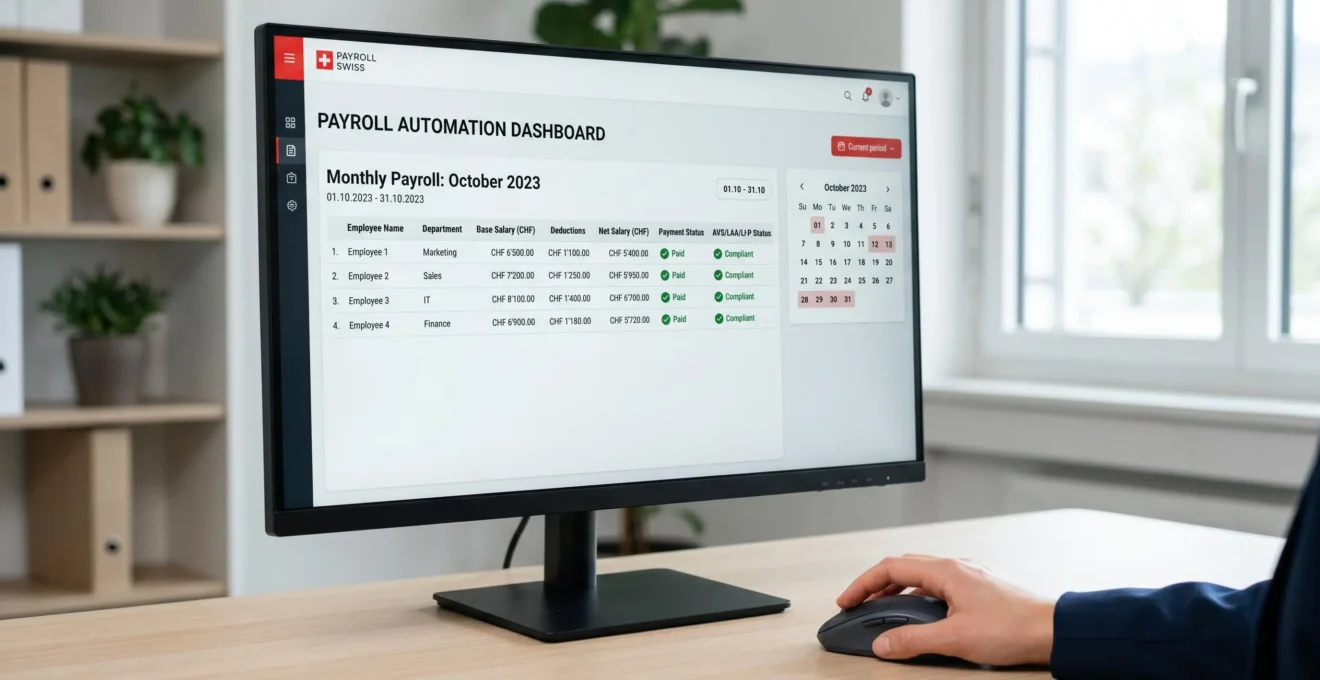
Scalability becomes particularly relevant during growth inflection points. A SaaS company expanding from 15 to 45 employees within 18 months faces complexity explosion with multi-canton workforce distribution and varying contract structures. External payroll partnership absorbs this complexity without requiring internal infrastructure that becomes a bottleneck.
Specialized providers typically achieve high calculation accuracy backed by verification processes and professional liability coverage. Reporting capabilities often exceed in-house spreadsheet systems, offering real-time dashboards with compliance status tracking, historical trend analysis, and export functionality for integration with accounting platforms.
The outsourcing decision: Matching your business stage to payroll strategy
Evaluating payroll outsourcing requires situational assessment rather than universal prescription. The decision framework centers on matching your company’s operational reality—employee count, workforce distribution, internal capacity, growth trajectory—against coordination demands Swiss payroll imposes.

Signals that external payroll management fits your situation
Certain business characteristics create natural alignment with outsourced payroll models. These indicators help leadership teams identify when external partnership delivers disproportionate value.
- Employee scale and distribution: Workforce of 10+ employees, particularly if distributed across multiple cantons
- Internal resource constraints: No dedicated payroll specialist, finance or HR team smaller than three people, or leadership time disproportionately spent on administrative compliance
- Growth trajectory: Headcount expanding more than 20% annually, preparing for funding rounds, or planning international expansion
- Compliance concerns: Uncertainty about AVS, LAA, or LPP calculation accuracy, filing deadlines, or previous retroactive correction demands
According to consolidated STATENT statistics from the Confederation’s KMU portal, 99.7% of Swiss enterprises qualify as SMEs. This concentration means most companies operate with resource constraints that make specialized external partnerships strategically attractive for non-core administrative functions.
When retaining control might still make sense
Very small teams—typically fewer than five employees in a single canton with stable headcount—may find coordination overhead manageable. Companies employing specialized payroll expertise internally possess institutional knowledge that reduces the value premium external providers offer. Businesses with highly customized compensation structures involving complex bonus calculations or profit-sharing may value internal system flexibility over standardized external platforms.
Common questions about outsourced payroll in Switzerland
What does outsourced payroll typically cost for a Swiss SME?
Pricing typically follows per-employee monthly fee models, varying based on employee count and payroll complexity. Compare visible fees against hidden in-house expenses: staff time valued at actual hourly rates, software subscriptions, training investment, and error correction overhead. Total in-house ownership costs often exceed external service fees once opportunity cost calculations factor in leadership time.
How is employee data security ensured?
Swiss data protection requirements mandate GDPR-compliant safeguards with data residency controls. Established providers implement encryption standards, role-based access controls, and audit trails. Service contracts should specify data handling protocols, provider liability for breaches, and your rights to audit security measures.
What does the transition process involve?
Onboarding progresses through discovery, data migration, platform configuration, parallel processing for verification, and final cutover. Timelines typically span four to six weeks for mid-sized companies. Employee disruption remains minimal while your finance team experiences reduced administrative burden immediately.
How do we select the right payroll provider?
Evaluate Swiss regulatory expertise depth, technology platform capabilities, service responsiveness, and pricing transparency. Request client references from companies at similar scale in your industry. Consider scalability: can the provider handle your projected growth? Compare total cost of ownership across providers against documented value through time recapture, compliance automation, and risk transfer.
Important considerations
This article provides general information about payroll outsourcing in Switzerland and does not constitute personalized business, financial, or legal advice. Swiss payroll regulations, social insurance rates, and tax laws evolve regularly; verify current requirements with official sources. Each business has unique needs; consult qualified payroll specialists or legal advisors before selecting a service provider. Cost-benefit analysis depends on your specific business size, complexity, and growth trajectory.
Potential risks to evaluate: Selecting an inadequate payroll provider could result in compliance errors, late filings, or incorrect employee payments. Data security breaches with sensitive employee information remain possible if providers lack proper safeguards. Some contracts include hidden costs or lock-in periods that reduce operational flexibility.
For compliance verification: Consult SECO (State Secretariat for Economic Affairs), cantonal tax authorities, or certified payroll consultants. For legal questions: employment law specialists or business attorneys.